
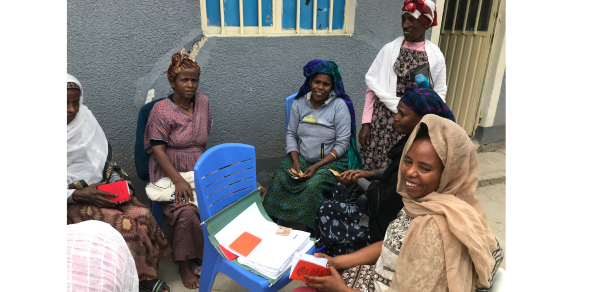
Running self-help groups in a war zone is no picnic, but as of now, 1,149 people in 68 groups are flourishing throughout Western Shewa and Addis Ababa. Together they have amassed over $33,000 in assets. In the cities where it is peaceful, loan repayment rate is 100%. Out in the countryside, where there is often fighting and travel is dangerous, it is only 99%. But what US bank would not love to have such statistics?
Every two months the mentors of these groups gather to give reports and get more training. Several walk ten hours through a rebel-infested forest, then take a bus for four more hours to reach the training site. Reverse that for their return trip. But they are doing well. Some grow wheat, hot peppers, coffee, or sugar cane. Some raise chickens or fatten cattle. One group is opening a shop to sell musical instruments.


During the last training in April, they discussed Resourcefulness. Often in the Bible, God asked people in great need, “What is in your hand?” For Moses, it was a stick. For a poor widow whose creditors were about to take her two boys, it was a jar of oil. For a hungry crowd, it was the two fish and five barley loaves in a little boy’s lunchbox. In each case, God was able to do amazing things through these simple objects—after their owners gave them to God.
As the mentors mapped out the material, natural, and human resources in their homes and villages, they exclaimed, “We didn’t realize we had such resources!” One newcomer to the group observed, “What a blessing it is to see such things from the Bible!”
That seems to be an important ingredient. They like our lessons but ask for “more Bible studies please! You only had two! Couldn’t we do four?” The local government in the area of these self-help savings groups wants to use our curriculum, Bible studies and all. We have six more lessons to write. Pray we can finish this faithfully so the next generations will get well trained.
Would you like to make a difference with Hope In View? Visit hopeinview.org/take-action to see the different ways you can change lives in Ethiopian communities.